How to Use a Window Squeegee Without Streaks
Most streaks are not the squeegee's fault. Learning how to use a window squeegee properly comes down to three habits: wet the glass enough, keep one stroke pattern from the first pass to the last, and dry the blade after every pull. Get those right and a modest hand squeegee will beat an expensive one used badly.
A squeegee is a handle carrying a rubber blade that pushes liquid off a flat surface, which is exactly how Wikipedia describes the tool. The design has barely changed in a century. Technique does the work.
What follows is the routine we would hand to a buyer's field team, plus the details that matter when you choose what to stock. Some of it is blunt, but skipping the blade wipe leaves you fighting streaks all day.
Where streaks actually come from
Glass is unforgiving. A streak is a thin film of water that dried with something in it, or a line of dirt the blade dragged instead of lifted. Four causes cover most of it.
- Too little water. A dry blade on dirty glass grinds dust into paste. Wet it, loosen it, then pull.
- A nicked edge. One small chip leaves a line down the whole pane, on every pass.
- Uneven pressure. Gripping hard at the middle and easing off at the ends flexes the rubber and lets water slip under.
- Sun, wind and warm glass. The water skins over before your blade arrives, and detergent residue stays behind.
Working cleaners handle all four the same way: keep the glass wet just ahead of the blade, work from the top down, and never let a pane dry half finished. The Wikipedia entry on window cleaners shows a trade kit that stayed simple for the same reason. Water, a blade, a cloth, a routine.
Wet the glass properly, then leave it wet
Fill a bucket with warm water and a few drops of dish soap. Not a foam bath. Too much detergent is its own streak source, because the film it leaves behind grabs dust within a day.
Wet the frames, sills and rubber gaskets before the glass. That is where the dirt sits, and a wet sponge dragged along the edge drags it onto the pane. Then load the applicator and wash the whole window in overlapping arcs, corner to corner. Let the water sit for a moment and lift the grime.
Work in shade, or on a cool pane, whenever you can. Direct sun on hot glass is the most common reason a good technique fails.
This is also why window cleaning sells better as a set than as one blade on its own. A customer who buys only the squeegee goes home without the wetting step, then blames the tool. Our window cleaning tools range is built around that logic, with washers, brushes and blades that pair up.
S-pattern or top-down? Choose once per pane
Two schools, both valid. Mixing them on the same pane is what leaves lift-off marks, those faint marks where the blade touched down again on half-dry glass.
| Stroke pattern | Best for | Watch out for |
|---|---|---|
| Top-down horizontal rows | Wide panes, shop fronts, dusty exterior glass | Water running down onto a row you already finished, so overlap and wipe the blade every pass |
| S-pattern (continuous snake) | Interior glass, mirrors, panes with clear elbow room | Needs steady pressure along the curve, or the turn leaves a swirl |
| Single pull-down sweeps | Small panes, final detail on large glass, fanlights | One stroke per wipe only, otherwise you smear the edge line |
Top-down wins on volume work. The S-pattern is faster on clean interior glass once your hand learns it. Either way, overlap each stroke by a couple of centimetres and keep the blade in contact with wet glass, not with dry glass.
The stroke routine, step by step
- Wet the whole pane, edges included, and keep it wet as you go.
- Scrub the frame line and corners first with the applicator or a brush.
- Dampen the blade itself. A dry rubber edge chatters across glass.
- Start at a top corner and tilt the blade slightly so water runs off the leading edge instead of under it.
- Pull across in one smooth pass, then lift and wipe the blade before the next one.
- Finish the edges with short inward pulls, not outward ones that push water onto the frame.
- Buff the sill and frame with a dry cloth so nothing drips back onto clean glass.
Two small things separate tidy work from average work. Keep the blade moving at a steady speed, and never stop mid-stroke to adjust your grip. Stop, and the water pools right where you paused.
Wipe the blade between passes (the step everyone skips)
Every stroke loads the rubber with soapy water and dirt. Carry that to the next stroke and you paint a thin film back onto the pane you just cleaned.
Keep a folded cloth in your back pocket and run it along the blade after each pull. Microfiber is the right cloth for the job because the split fibres lift and hold water and grit rather than pushing them around, which is the mechanism set out in the Microfiber entry. Cotton works fine too. It just needs changing more often.
Blunt opinion: if a crew has streaks and one cloth between them, the problem is the cloth count, not the squeegee. Streak free windows come from routine, not from a pricier blade.
Telescopic poles: reach without a ladder
Poles earn their place on shop fronts, atrium glass, conservatory roofs and upstairs windows cleaned from inside. The mechanics change, though. A long lever makes even pressure harder, so the head joint and the locking collar matter more than the blade does.
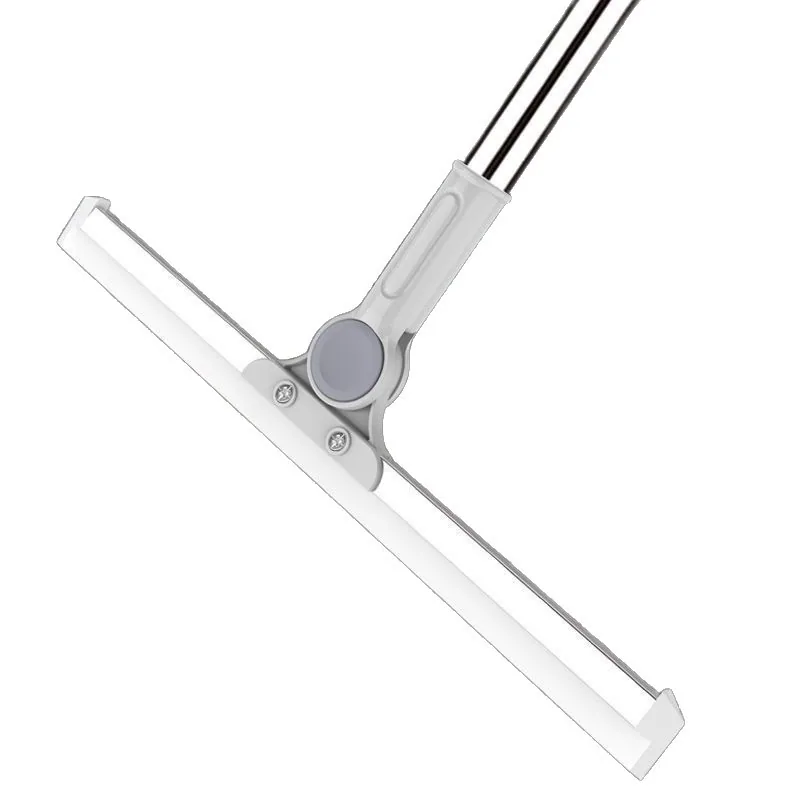
Our telescopic rod window cleaner with 28cm panel puts a wiper on one side and a scraper on the other, so one hand loosens dust and pulls the water film off the same strip. The 28cm head suits wide panes. Minimum order on that item is 1,000 pieces.
If you are specifying a pole for a retail listing, check three things: how the collar locks, how much the pole weighs when extended, and whether the head can be replaced separately. A pole that dies because of a worn blade is a returns problem waiting to happen.
Foldable squeegees, screen brushes and the rest of the kit
Not every buyer wants the same tool. Household glass and shop glass are different jobs.
The Foldable Plastic Window Squeegee is the domestic answer: a plastic body that folds down for storage between jobs, in ivory or sky blue, at a minimum order of 600 pieces. It fits a kitchen drawer, which is where most home users want it.
Screens first, glass second. The Window Screen Dust Brush carries a hooked flannel face that grips pollen, dust and pet hair out of fine mesh before it turns into mud on the pane behind it. Skipping the screen is how a clean window gets dirty again in a week.
For corners and frame joints, where a square blade simply cannot reach, the Triangular Glass Cleaner uses a triangular head with a high-density 80/20 polyester face. And for outside faces that cannot be reached from outside, the Magnetic Window Washer holds an indoor and outdoor unit together through the glass with rare-earth magnets, so one person cleans both sides.
What to check before you stock
Streak complaints are rarely about the glass. They come back to blade quality, handle stiffness and whether the product matches the job the buyer imagined. This is the short checklist we would run through with an importer.
| Spec | Why it decides complaints | What to confirm |
|---|---|---|
| Blade material and edge | Rubber and silicone behave differently on cold glass and on tinted film | Which material suits your market's climate and surfaces |
| Blade replaceability | A worn edge is the most common streak cause after a year of use | Whether spare blades can ship in the same carton |
| Handle strength | Flex under pressure breaks the seal along the glass | Reinforced stainless steel or aluminium, 0.4 to 0.6 mm wall |
| Head width and fold | Width drives speed; folding drives shelf space | Retail pack dimensions against your shelf plan |
| Colour and packing | Own-brand programmes live or die on shelf presentation | Colour to Pantone code or sample, logo and carton marks |
Our own products have to pass a drop test before they leave the factory, and handles are reinforced stainless steel or aluminium at 0.4 to 0.6 mm wall thickness. That matters for a window tool, because the handle is what keeps the blade flat.
For private label, colours can be matched to Pantone codes or your own colour samples, with logos by embroidery, silk print or heat print, plus colour boxes, hot-stamped logos, carton marks and product labels. A pre-production sample is confirmed before mass production. PCR plastic parts and recycled cotton fibre options are available if your market asks for them.
How to start an order with us
Two routes. Stock items from our window cleaning tools range, where each listing carries its own minimum order: 600 pieces for the foldable squeegee, 1,000 for the telescopic rod, and on request for the others. Or your own brand through OEM and ODM, at 2,000 to 8,000 pieces per style per colour.
Email mopglohome@gmail.com with the item, quantity, destination market and any colour or packing requirements, or send the quote form. CHUANGJIE has been in Yiwu, Zhejiang since 2006, with 3,000+ SKUs and a showroom of more than 200 square metres in the International Trade Mart. Production runs on 300+ injection moulding machines with annual output above 5 million units, and export handling covers inspection, consolidation in Yiwu, customs clearance and both FCL and LCL shipments.
FAQ
Should a squeegee be used on wet or dry glass?
Wet only. Wash the pane first with soapy water, keep it wet ahead of the blade, and dampen the rubber edge before the first pull. A dry blade on dry glass just drags dirt and leaves a film.
Why do streaks appear at the edges of the pane?
Usually water pushed onto the frame on the outward stroke, or a dirty blade carrying grime from the frame line. Scrub frames and gaskets before the glass, finish edges with short inward pulls, and wipe the blade after every pass.
Do telescopic poles work as well as a hand squeegee?
For reach, yes. On a long pole the lever makes even pressure harder, so the head joint and locking collar matter more than the blade. Check both before you commit to a stock order, and ask whether the head is replaceable.
What is the minimum order for your window cleaning tools?
Stock items each carry their own minimum on the listing: 600 pieces for the foldable plastic window squeegee and 1,000 for the telescopic rod window cleaner, with others on request. OEM orders run from 2,000 to 8,000 pieces per style per colour.