Magnetic Window Cleaner: How It Works and Who It Suits
A magnetic window cleaner is a two-part glass tool: one half stays in your hand inside the room, the other half sits on the outside of the pane, and magnets hold the pair together through the glass. Slide the inside half and the outside half follows it. That is the whole trick, and it is why the category keeps selling. No ladder. No leaning out of a bedroom window.
A double sided window cleaner of this type is not a gadget for everyone, though, and the difference between a tool that works and one that ends up in a returns bin comes down to two specs and one accessory. Our own version is the Magnetic Window Washer, part of the wider window cleaning tools range. Here is how the tool works, where glass thickness changes the order, and which buyers it genuinely suits.
How two halves clean both sides of the glass
Each unit carries a working face: a pad that holds water and lifts dirt, sometimes with a squeegee lip or a scraper on the same body. The magnets clamp both faces against the two glass surfaces at once, so one pass wipes inside and outside together.
You wet the pad, set the outside half on the glass, then bring the inside half up to meet it through the pane. Move in slow, overlapping passes, top to bottom, and keep a firm grip on the inside half the entire time. Nothing else touches the outside face.
That is also the honest limitation. On an upper floor, the outside half is doing a job nobody can reach up and inspect. Which is why the cord and the thickness rating matter more than the colour of the plastic.
Glass thickness is the spec that decides the order
Magnetic force drops off fast with distance. Two magnet faces touching hold far harder than the same pair separated by a pane of glass. Thickness is not a footnote on the spec sheet. It is the design input.
A thin single pane, a sealed double-glazed unit, laminated safety glass, a window with an applied film: each puts a different gap between the halves. Fit a thicker pad and the gap grows again, so pad choice and magnet grade have to be tuned together rather than picked separately.
For buyers, that means getting the stated glass thickness range in writing and printing it on the box and the listing. A unit built for thin single glazing will slip, chatter or let go on a sealed double-glazed unit, and the review that follows sits under your label, not the factory's. If your market is mostly double glazed, specify for that from the start. Do not assume one magnet grade covers a country's housing stock.
Frames matter as much as glass. External security bars, deep glazing bars that divide a pane, and windows that tilt inward all interrupt the smooth path the outside half needs. Walk the market before you commit: an apartment-heavy city and a suburb of detached houses want different tools.
The safety cord is part of the product, not an add-on
Every tool of this type needs a cord or leash anchored to the outside half and looped to something solid indoors. It is the only backup if the pair separates or the outside half slides off the top edge.
Two things to check when sampling. First the anchor: how the cord is fixed to the tool body, and whether a hard tug would pull it out. Second the warning copy on the pack, because fingers get pinched when the halves snap together, and it hurts.
Brief the user in one line as well. Separate the halves by sliding, never by pulling them straight apart. That single sentence prevents a lot of angry emails.
Pads, scraper lips and what to specify
The pad does the cleaning. Magnets only hold it against the glass. A denser pad carries more water and scrubs a grimy pane better; a softer, more open pad releases water quickly and rinses clean under a tap. Both are fine if the pad is replaceable and you can buy spares.
Spares are a quiet profit line. A two-pack of replacement pads on the shelf beside the tool sells to the same customer twice. Ask any supplier, us included, whether the pad face is a separate SKU with its own carton.
Across our cleaning range we work with PVA sponge, chenille microfiber, cotton yarn and 80/20 polyester-polyamide microfiber pads, so a particular pad face on a window tool is a conversation with our product team rather than something we would promise blind. Tell us the finish you want and we will tell you what is realistic.
Telescopic squeegees and where they beat magnets
A squeegee, in the plain sense, is a tool with a blade that pulls liquid off a flat surface, and it has been the default for glass for a long time (Squeegee, Wikipedia). Professional window cleaning is a trade with its own kit and methods (Window cleaner, Wikipedia), and most of that kit is still a blade on a pole.
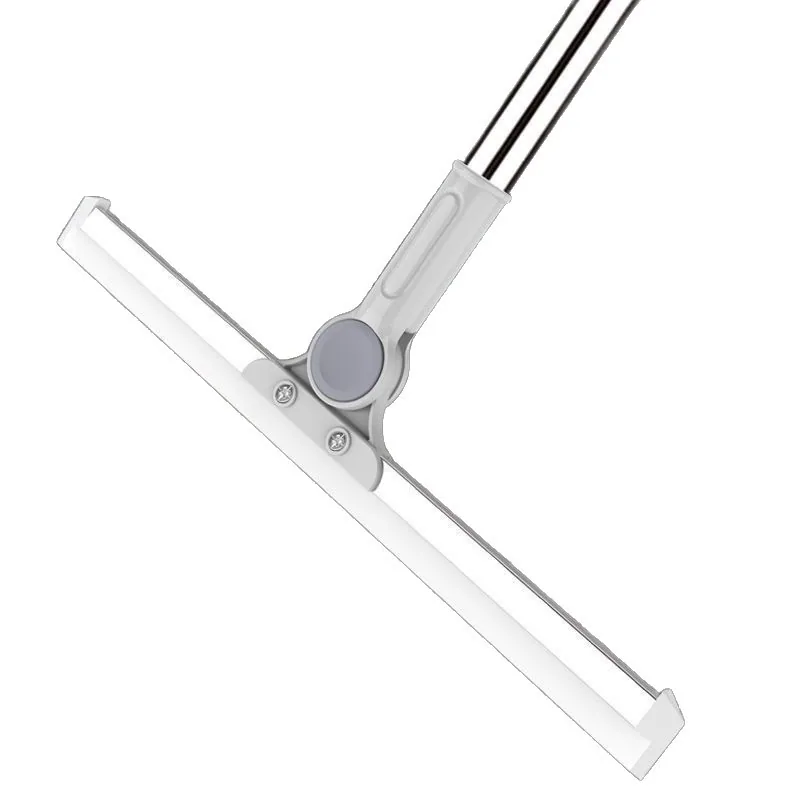
A telescopic rod window cleaner reaches a shopfront or a ground-floor pane in one pass, costs less to make, and usually leaves less water film than a magnet pair. A foldable hand squeegee covers mirrors and interior glass for very little money. Both belong in the same aisle as the magnetic tool.
Magnets win on reach without access. Think a townhouse window above a conservatory roof, a balcony window, a shop with a busy pavement outside. That is where a shopper pays for the tool rather than for a cheaper blade.
| Tool | Reach | Outside access needed | Best panes | Shelf position |
|---|---|---|---|---|
| Magnetic window cleaner | Any height, worked from inside | No | Sealed double glazing, upper floors | Mid to premium |
| Telescopic rod window cleaner | Ground floor to low first floor | Yes, or a long pole from inside | Shopfronts, plate glass, single panes | Value to mid |
| Hand or foldable squeegee | Arm's length | Yes | Mirrors, interior glass, reachable exterior | Value, high volume |
Who it suits, in channel terms
Good fit: mid to premium homeware shelves, hardware chains with a window and door care section, e-commerce listings where a short demo video does the selling, and spring cleaning promotions. That shopper already has double glazing, already owns a ladder they do not enjoy climbing, and is buying convenience as much as a cleaning tool.
Poor fit: discount price baskets, where a magnet upgrade will not survive the cost-down, and markets where single-glazed timber windows still dominate. A pole or a hand squeegee does that job for less.
Blunt version. This is a product where cheap versions exist and fail, and the category carries a trust problem because of it. Put your own label on it and you should sell the version rated for thicker glass, price it properly, and say so on the front of the pack.
Before you commit to a container
- Glass thickness range stated on the listing, the colour box and the carton mark.
- Magnet grade confirmed, plus whether the two halves are a matched pair that cannot be mixed with another size.
- Safety cord with an anchor you have tugged on yourself.
- Replacement pads available as a separate SKU.
- Pinch warning and the slide-to-separate instruction printed in the destination language.
- Drop test confirmation. Products from our factory must pass a drop test before leaving, and our reinforced stainless steel or aluminium handles are specified at 0.4 to 0.6 mm wall thickness.
- One sample kept back as the reference against the production run.
Stock items or OEM: starting an order
We have been making household cleaning tools in Yiwu since 2006, with a showroom of more than 200 square metres in the International Trade Mart and a range of 3,000+ SKUs. Around 300 injection moulding machines and an annual output above 5 million units sit behind the catalogue, and products go to more than 20 countries and regions. Our R&D team of 20+ senior technical staff and nearly 300 patents covers new materials, moulding processes and moulds, which is useful when a magnet housing needs changing rather than just recolouring.
For a private-label run, the path is straightforward. Confirm quantity, place the order, sign the contract, pay the deposit. Send Pantone codes or colour samples plus logo files, and we handle colour, material and style changes, then a pre-production sample before mass production. Logos go on by embroidery, silk print or heat print; packaging can include colour boxes, hot-stamped logos, carton marks and product labels. OEM minimums run 2,000 to 8,000 pieces per style per colour. PCR plastic parts and recycled cotton fibre are available if your buyers ask for them. Stock items carry their own minimum on each listing, so check the product page for the exact figure on that item.
Order handling is end to end: confirmation, production scheduling, quality inspection, warehousing and consolidation in Yiwu, customs clearance, booking and shipment, FCL or LCL. Send your spec to mopglohome@gmail.com, or use the contact form. If you want the background on the category first, read our magnetic window cleaner guide, and browse OEM and ODM for how custom work runs.
FAQ
How does a magnetic window cleaner clean both sides at once?
Each half carries a cleaning pad against one face of the glass. Magnets hold the inside and outside units together through the pane, so when you move the inside half the outside pad travels with it and both surfaces get wiped in the same pass.
Will it work on double-glazed or thick windows?
Only if the tool is rated for that glass thickness. Magnetic force drops sharply as the gap between the halves grows, and double-glazed units, laminated glass and thick pads all increase that gap. Ask for the stated thickness range and put it on the packaging so buyers match the tool to their windows.
What stops the outside half from falling?
A safety cord anchored to the outside unit and looped to something solid indoors. That cord is the only backup if the magnets separate or the unit slides off an edge, so check the anchor point yourself and keep the pinch warning and slide-to-separate instruction on the retail pack.
Can we order it under our own brand, and what is the minimum?
Yes. OEM minimums run 2,000 to 8,000 pieces per style per colour. Colours are matched to Pantone codes or samples, logos go on by embroidery, silk print or heat print, and packaging can be customised. Stock items carry their own minimum on each product listing.