Squeegee Blade Replacement: Rubber vs Silicone and When to Swap
Most squeegee complaints that reach a buyer are not tool failures. They are blade failures. Streaks that dry into a film, a thin bead of water left at the edge of every pass, a lip that has gone stiff and shiny: all of that points to squeegee blade replacement long before the handle or the frame gives up. The hard part is knowing what to put back in. Rubber and silicone behave differently on glass and on tile, and a replacement blade that fits the channel but fights the floor is a returned carton waiting to happen. Below: the signs, the materials, the sizing numbers, and how to stock spares without bloating the range.
Squeegee blade replacement: rubber vs silicone and when to swap
Six signs the blade is finished
Train whoever answers the after-sales inbox to ask one question first: does the tool leave water behind in the same pattern every time? If yes, suspect the blade before the technique.
- Streaking. A clean blade pulls an even film. A worn one leaves lines that sit in the same place, pass after pass.
- Nicks and tears. Grit, glass chips and rough concrete take bites out of a soft lip. Even a small nick leaves a visible trail.
- Hardening or glazing. A blade that has gone shiny and stiff has lost its grip on the water film. It skates instead of squeegeeing.
- Cupping or a curled edge. Stored leaning on its head, a blade takes a set and the edge no longer meets the surface flat.
- A loose blade in the channel. Rattling usually means the fixing has stretched or the wrong thickness went in.
- Black marks on pale floors. Degraded rubber deposits pigment. On light tile that reads as a defective tool, even when the blame belongs to storage.
One quick check before you refund anything: is the edge actually clean? A blade carrying a dried rim of detergent streaks exactly like a worn one. Our walkthroughs for window squeegees and floor squeegees cover the technique side in more detail.
Natural rubber: still the default for a reason
Natural rubber comes from latex and is valued for elasticity and rebound (Wikipedia). In a squeegee that means the lip conforms to slightly uneven tile, grout lines and worn concrete, and it grips the water film rather than sliding over it. That is why so many floor squeegees, and most professional window channels, are still built around a rubber blade.
Weak points, broadly: oils, solvents, prolonged UV and ozone. Store a rubber-bladed tool hanging, not pressed flat under other stock, and it behaves. Leave it in a hot van for long enough and it will let you know.
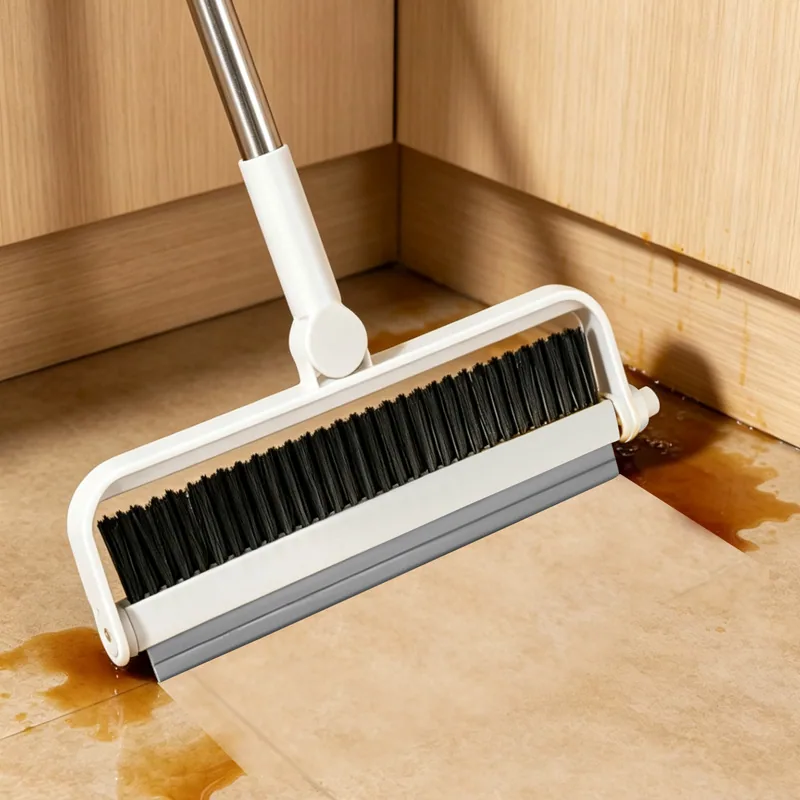
Our own Floor Squeegee Head is built around a high-elasticity natural rubber blade, with a rigid PP or zinc-plated reinforced steel channel behind it. Soft edge, stiff housing. That pairing is what keeps the lip flat under load.
Silicone: heat, cold and chemicals
Silicone rubber is a synthetic elastomer with a silicon-oxygen backbone, chosen where temperature range, UV and oxidation resistance matter (Wikipedia). In a blade it translates into a lip that keeps its flexibility across hot and cold wash-down work, holds up to hardening, and does not stain pale surfaces the way degraded rubber can.
Trade-offs exist. Silicone usually costs more per blade, and some users find it glides across a glass pane rather than biting the water film, which is part of why rubber still dominates window work. Where silicone wins outright: bathroom and shower tools, food areas, cold rooms, outdoor use, and any surface where a black mark is unacceptable.
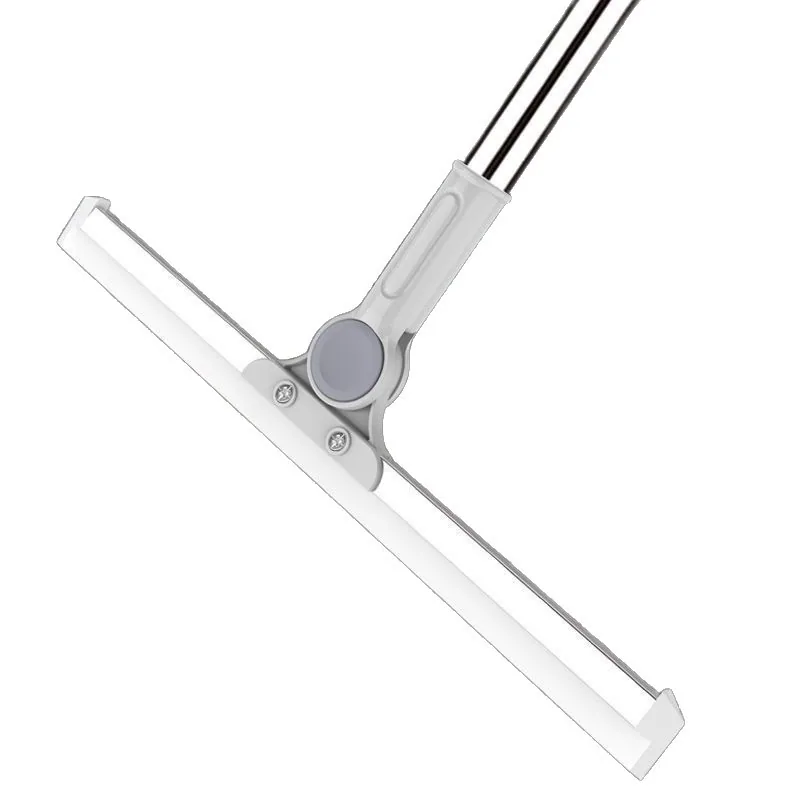
In our range, the Soft Silicone Floor Squeegee carries a soft silicone wiping edge on a stainless steel frame in 35 cm, 45 cm and 50 cm widths. The double-sided silicone floor squeegee puts a strip on both sides, so the user can pull toward or push away without turning the head.
Rubber or silicone: the comparison buyers ask for
Use this as a quoting sheet rather than a rulebook. The right answer depends on the surface your market actually cleans.
| Property | Natural rubber blade | Silicone blade |
|---|---|---|
| Water pickup on glass | Grips the film; the classic window choice | Glides; sample it before you commit |
| Uneven tile and grout | Conforms well | Conforms, slightly firmer feel |
| Heat and cold | Sensitive to long heat exposure | Wide working temperature range |
| UV and ozone outdoors | Degrades over time | Holds up well |
| Oils and solvents | Can swell and soften | Holds up better |
| Pale floors | Can leave black rub once degraded | Low marking |
| Cost per blade | Lower | Higher |
| Typical fit | Floor squeegees, window channels, workshops | Bathrooms, food areas, cold rooms, outdoor |
Measuring for replacement squeegee blades
Fit is where accessory orders go wrong. A blade that is a couple of millimetres out will either drop out mid-pull or buckle in the channel. Get these five numbers before you ask anyone for a quote:
- Channel width, measured inside the housing, not the overall tool width.
- Blade thickness at the base. This is the number suppliers need most and buyers forget most often.
- Fixing method: clamp and screw, push-in slot, or moulded-in.
- Edge profile: straight, double-edge, notched, or foam-backed.
- Hole or slot spacing where the blade is pinned or riveted.
Watch the naming too. A 45 cm squeegee rarely takes a 45 cm blade, because the housing overlaps on both sides. Ask for the blade dimension, not the tool dimension.
And accept that some tools are not worth re-blading. On a low-cost household squeegee with a moulded-in edge, replacing the whole head is cheaper than stocking a blade nobody can fit. Blunt, but true.
Stocking spares: the small-SKU way to do it
Blades are the consumable part of a tool that otherwise lasts and lasts. Sell them as an accessory line and you get repeat purchase on an item that ships cheap. A few practical rules:
- Hold blades only for the two or three squeegees you sell hardest. A rail with twelve references nobody recognises is dead space.
- Put the fit on the pack. A line reading "fits 45 cm floor squeegee, 3 mm slot" beats a nice photo every time.
- Bundle blade with tool for first-time buyers, sell blade alone for repeat buyers.
- Check spare availability before you commit to a tool range. Plenty of suppliers only ship complete units.
Ask us what we can supply as a spare for the items in our range. For anything with a moulded-in edge, the honest answer is a replacement head, and we would rather tell you that than ship a blade that will not fit.
Where our blades sit in the range
We have been building household cleaning tools in Yiwu since 2006, and the range now runs past 3,000 SKUs across mops, brushes, window cleaners and floor tools. On the squeegee side, two blade materials are in play. The floor squeegee head uses rubber for water pickup; a closed-cell EVA foam option suits lighter duty and dry debris. Browse the full floor squeegees and window cleaning tools categories for the wider picture, including the foldable plastic window squeegee, the triangular glass cleaner and the telescopic rod window cleaner with 28 cm panel.
Build quality behind the blade matters as much as the blade. Products must pass a drop test before they leave the factory, and reinforced stainless steel or aluminium handles run 0.4 to 0.6 mm wall thickness so they resist bending and rust. Blade material, blade thickness and frame stiffness can all be adjusted for a market under OEM, with colours matched to Pantone codes or your own colour samples.
How to start an order with us
Two routes, depending on where your volume sits.
For stock items, each listing carries its own minimum order. The soft silicone floor squeegee and the double-sided telescopic version sit at 500 pcs; the 2-in-1 floor squeegee and scrub brush, the foldable plastic window squeegee and the 28 cm telescopic panel run at 600 pcs or 1,000 pcs as shown on the listing. Take the figure on the listing as the figure for that item only.
For OEM, minimum order runs 2,000 to 8,000 pieces per style per colour. You confirm quantity, the contract is signed and the deposit paid, you send colour samples or Pantone codes plus logo files, we customise colour, material and style, and a pre-production sample is confirmed before mass production. Logo options include embroidery, silk print and heat print; colour boxes, hot-stamped logos, carton marks and product labels are all available. PCR plastic parts and recycled cotton fibre are options if your buyers ask for them.
Email mopglohome@gmail.com with the blade dimension, the tool it fits and your target market, or send the same details through the quote form on our contact page. Still choosing between rubber and silicone for a new line? Say so in the first message. That is a sample conversation, not a catalogue one. Full OEM detail sits on the OEM and ODM page.
FAQ
How do I know when a squeegee blade needs replacing?
Look for a repeating pattern: streaks that land in the same spot on every pass, a thin line of water at one edge, visible nicks, or an edge that has gone shiny and stiff. A blade that rattles in its channel or has cupped from being stored on its head is also finished. Clean the edge first, because dried detergent imitates a worn blade.
Should I choose natural rubber or silicone replacement squeegee blades?
Natural rubber conforms well to tile and grout and grips the water film, which is why it still dominates floor and window work. Silicone handles heat, cold, UV and chemicals better and marks pale surfaces less, so it suits bathrooms, food areas, cold rooms and outdoor use. It usually costs more per blade, and some users find it glides on glass.
What measurements do I need before ordering replacement squeegee blades?
Five: the channel width measured inside the housing, the blade thickness at the base, the fixing method (clamp and screw, push-in slot or moulded-in), the edge profile, and the hole or slot spacing. Measure the blade, not the tool: a 45 cm squeegee rarely takes a 45 cm blade because the housing overlaps at both ends.
Can I order squeegee blades and tools from you as an OEM or private label?
Yes. OEM minimum order is 2,000 to 8,000 pieces per style per colour, with colours matched to Pantone codes or your samples, logo by embroidery, silk print or heat print, and custom colour boxes and carton marks. A pre-production sample is confirmed before mass production. For stock items, the minimum order shown on each listing applies to that item.