How to Use a Floor Squeegee on Tile, Concrete and Wet Rooms
Learning how to use a floor squeegee comes down to two things: blade angle and pull direction. Nail both and a wet tiled kitchen or a concrete garage floor goes from standing water to a damp film in a handful of passes. Nail neither and you push the same puddle around for ten minutes. That matters to buyers more than it sounds, because technique tells you what to source: blade material, blade width, handle length, and whether one tool has to scrub and dry the same floor.
We make floor squeegees and the rest of the wet-floor kit here in Yiwu, and we sell them to importers, wholesalers and private-label brands. Here is the working method, plus what each choice means when you write a spec sheet.
Set the blade angle before you move
Most bad squeegee work is an angle problem. Stand the handle too upright and the blade edge chatters, skips over grout lines and leaves trails. Lay the handle too flat and the rubber curls under, so you smear water instead of pushing it.
The sweet spot is a low handle, roughly 30 to 45 degrees off the floor, with the blade edge lying almost flat and leaning a few degrees in the direction you are travelling. Short strokes confirm it. If the blade grabs and jumps, you are too upright. If water spills over the top of the blade, you are too flat or moving too fast.
Handle length is the other half. For a 35 to 45 cm blade on a bathroom floor, a handle around 120 cm keeps the user's back straight. Wide wet rooms want longer. Give the user room to stand behind the blade, not on top of it.
The overlapping pull that actually moves water
This is the floor squeegee technique that separates a contract cleaner from a homeowner with a puddle:
- Start at the point furthest from the drain, not next to it.
- Work in lanes about two thirds of the blade width apart.
- Overlap each pass by a few centimetres so no strip of water is left between lanes.
- Pull in one direction, lift the blade at the end of the stroke, then reset. Dragging the blade back on the return just re-wets the floor you cleared.
- Finish the last lane at the drain, then make one dry pass over the whole area.
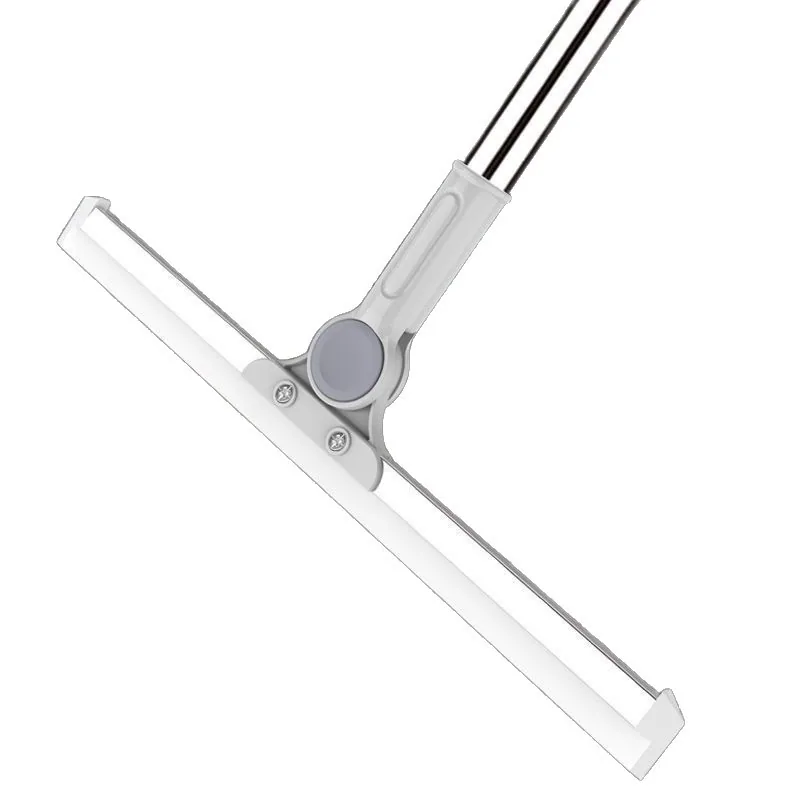
Push or pull? Both work. Pushing gives more control on a wide blade; pulling gives more downward pressure on a stubborn film. Double-edged heads such as our double-sided silicone floor squeegee with telescopic handle let the user switch without turning the tool around, which is why buyers place them in bathroom and workshop ranges.
To squeegee water off floor quickly, keep the blade loaded. A blade pushing a two centimetre wave of water clears better than one skimming a thin film, because the water itself helps seal the edge against the floor.
Tile, concrete and wet rooms are three different jobs
Tile
Glazed porcelain and polished stone are the easy case. A soft silicone edge glides, does not mark, and leaves very little behind. Textured tile is harder, because water sits in the pattern and in the grout lines, so pull along the grout lines rather than across them and accept a second pass. On large-format tile a 45 or 50 cm head cuts the time sharply. Our soft silicone floor squeegee is listed in 35 cm, 45 cm and 50 cm widths for exactly that reason.
Concrete
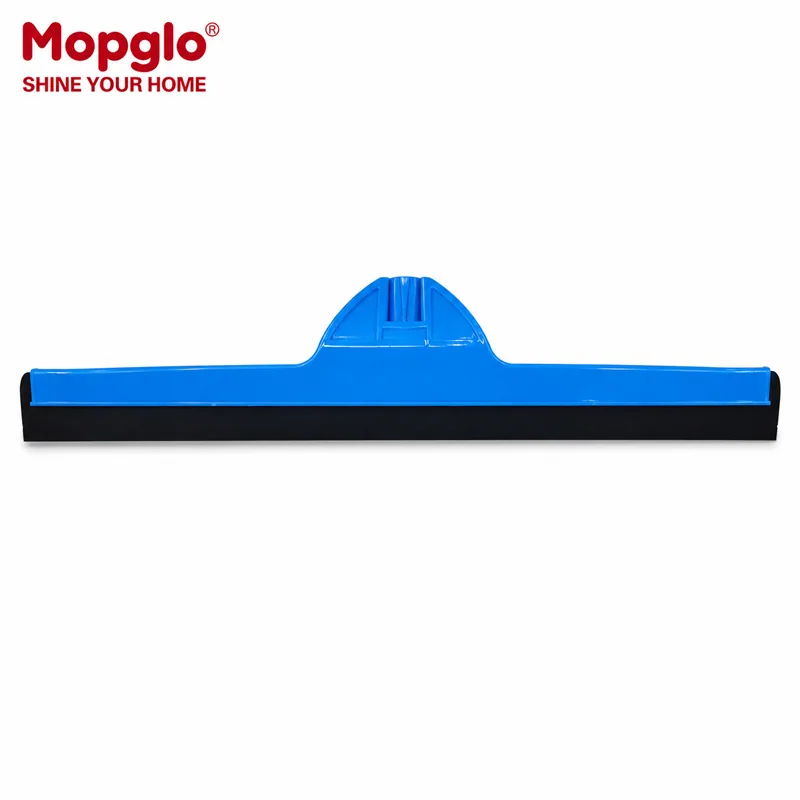
Concrete is porous and abrasive. A silicone edge wears faster on it and can skip across a rough screed, while a natural rubber blade bites better and tolerates grit. Sealed concrete behaves more like tile. Unsealed concrete, garage floors and loading bays need a heavier housing and a blade with some stiffness, which is what our floor squeegee head is built for, with a high-elasticity natural rubber blade or a closed-cell EVA foam blade in a PP or zinc-plated steel housing.
Wet rooms and showers
Small area, one drain, tile everywhere. The strip of floor between the drain and the wall is where water sits, so work from the far wall toward the drain in short lanes with a narrower head. A 2-in-1 tool earns its place here, because the same person scrubs the shower and then clears it. See the 2-in-1 long-handle floor squeegee and scrub brush.
Silicone or rubber: pick by substrate, not by price
| Blade | Best on | Edge behaviour | Wear pattern | Watch out for |
|---|---|---|---|---|
| Silicone | Glazed tile, stone, smooth floors, bathrooms | Glides, resists most household chemicals, does not mark | Slow, tends to round off rather than chip | Can skip on rough or very dry concrete |
| Natural rubber | Concrete, screed, mixed floors, heavy water | Grips well, high elasticity, seals against grit | Faster on abrasive floors | Can leave marks on very pale unsealed surfaces if dragged hard |
| EVA foam | Very wet floors, coarse concrete, first-pass clearing | Soft, conforms to uneven floors | Compresses over time | Less precise finish, best as a first pass |
Two notes for spec sheets. Blade hardness is not something end users think about, but a softer compound conforms better to uneven floors and a firmer one clears standing water faster, so ask us about the compound instead of guessing from a photo. And silicone rubber holds its flexibility across a wide temperature range, which is why it turns up in wet rooms and cold rooms alike (Silicone rubber, Wikipedia). For background, the floor cleaning overview covers the wider job, and the squeegee entry covers the tool itself.
Clean the blade, or the blade cleans badly
Grit under the edge is what turns a squeegee from a water pusher into a scraper that scratches. Rinse the blade after every wet job, run a thumb along the edge to feel for nicks, and store the tool hanging or blade-up, never resting on the edge.
A nicked blade leaves a thin line of water on every pass. That is the moment to replace the head rather than press harder. Stocking replacement heads beside the complete tools is a small decision with a real payoff, because it keeps the customer on your listing instead of buying a whole new tool elsewhere. Our replacement head fits the commercial range.
2-in-1 squeegee brushes: when one tool has to do both
A squeegee brush combo is the right answer for bathrooms, kitchens, small retail back rooms and cleaning trolleys, where space in the bucket or on the cart is tight. One side scrubs the grout or the shower tray, the other pulls the water to the drain. The trade-off is honest: a combo head is usually a compromise on both edges, so it suits lighter domestic and light commercial use rather than heavy contract cleaning.
Building a range? The usual split is a 2-in-1 combo for household and bathroom, a straight silicone squeegee for tile and stone, a heavier rubber-bladed head for concrete and industrial, and a double-sided telescopic model wherever reach matters. That is roughly the shape of our own floor range, which you can see at floor squeegees.
What to check before you stock
- Substrate mix in your market. Mostly tile and stone? Silicone. Concrete and garage floors? Rubber.
- Widths. 35 cm for bathrooms, 45 to 50 cm for kitchens, corridors and open floors.
- Handle. Fixed or telescopic, and whether the fitting matches other tools you already carry.
- Housing. PP for light domestic, steel for contract and industrial.
- Packaging. Hanging card for DIY retail, plain carton for distributors.
- Replacement heads. Sell them, or someone else will.
Worth reading next: floor squeegee vs mop for the selling story, and squeegee blade replacement for the after-sales angle.
Start an order with us
CHUANGJIE has been making household cleaning tools since 2006, with more than 3,000 SKUs, a showroom of over 200 square metres in District 4 of the Yiwu International Trade Mart, and 300+ injection moulding machines behind an annual output above 5 million units. Products ship to 20+ countries and regions.
Two routes. Stock items carry their own minimum on each listing, so you can test a market small. OEM runs at 2,000 to 8,000 pieces per style per colour, with Pantone colour matching, logo by embroidery, silk print or heat print, custom colour boxes and carton marks, and a pre-production sample confirmed before mass production. Wall thickness on our reinforced stainless steel and aluminium handles runs 0.4 to 0.6 mm, and products must pass a drop test before they leave the factory.
Email mopglohome@gmail.com with your market, the substrates your customers clean most, and the widths you want. Or send the details through the quote form on our contact page. For the private-label process end to end, the OEM and ODM page walks through it, and about us covers the factory.
FAQ
What blade angle should a floor squeegee be held at?
Keep the handle low, roughly 30 to 45 degrees off the floor, with the blade edge lying almost flat and leaning slightly in the direction of travel. If the blade chatters, the handle is too upright. If water spills over the top of the blade, it is too flat or you are moving too fast.
Silicone or rubber blade for concrete floors?
Natural rubber for unsealed concrete, screed and garage floors: it bites into a rough surface and tolerates grit better. Silicone suits glazed tile, polished stone and wet rooms, where it glides without marking. EVA foam is a good first-pass blade on very wet, coarse floors.
Why does my squeegee leave a thin line of water behind?
Usually a nick or grit in the blade edge. Rinse the blade after each job, check the edge with a thumb, and replace the head once it is damaged rather than pressing harder. Pressing harder curves the blade and makes the streak wider.
Can I order floor squeegees under my own brand?
Yes. Stock items have their own minimum on each listing if you want to test a market small. OEM orders run at 2,000 to 8,000 pieces per style per colour, with Pantone colour matching, logo by embroidery, silk print or heat print, custom packaging and a pre-production sample confirmed before mass production.